
9 – minute read
Why Your Business Needs a Website (Even If You’re Already on Instagram and WhatsApp)
First published: Sep 23, 2026
Last modified: Sep 23, 2026
Quick answer:
A website is your business’s own address on the internet: a set of pages people can find on Google, read anytime, and use to contact you. Most Singapore businesses need one because customers check you online before they call. Social media and WhatsApp help you talk to people. Your website is where they decide to trust you.
Someone just recommended your business to a friend. The first thing that friend does is type your name into Google. What do they find? An Instagram or TikTok page last updated in March? A Facebook post with your old phone number? Or nothing at all?
I’ve built websites for Singapore businesses for more than 15 years. Good businesses lose customers in that quick Google check all the time, not because of price or quality, but because they look hard to trust online. This guide answers the questions owners ask me most: what a website is, whether you really need one, and what to build if you do.
Key takeaways
- A website is the only online space you fully control. Social platforms set their own rules.
- Its main job is to turn “Who is this business?” into “Let me contact them.”
- A website doesn’t guarantee Google rankings. It gives you something that can rank.
- Instagram, WhatsApp and your Google Business Profile work best when they point to a website.
- Start small. A few clear pages beat a big site nobody updates.
What Is a Website? (The Simple Answer)
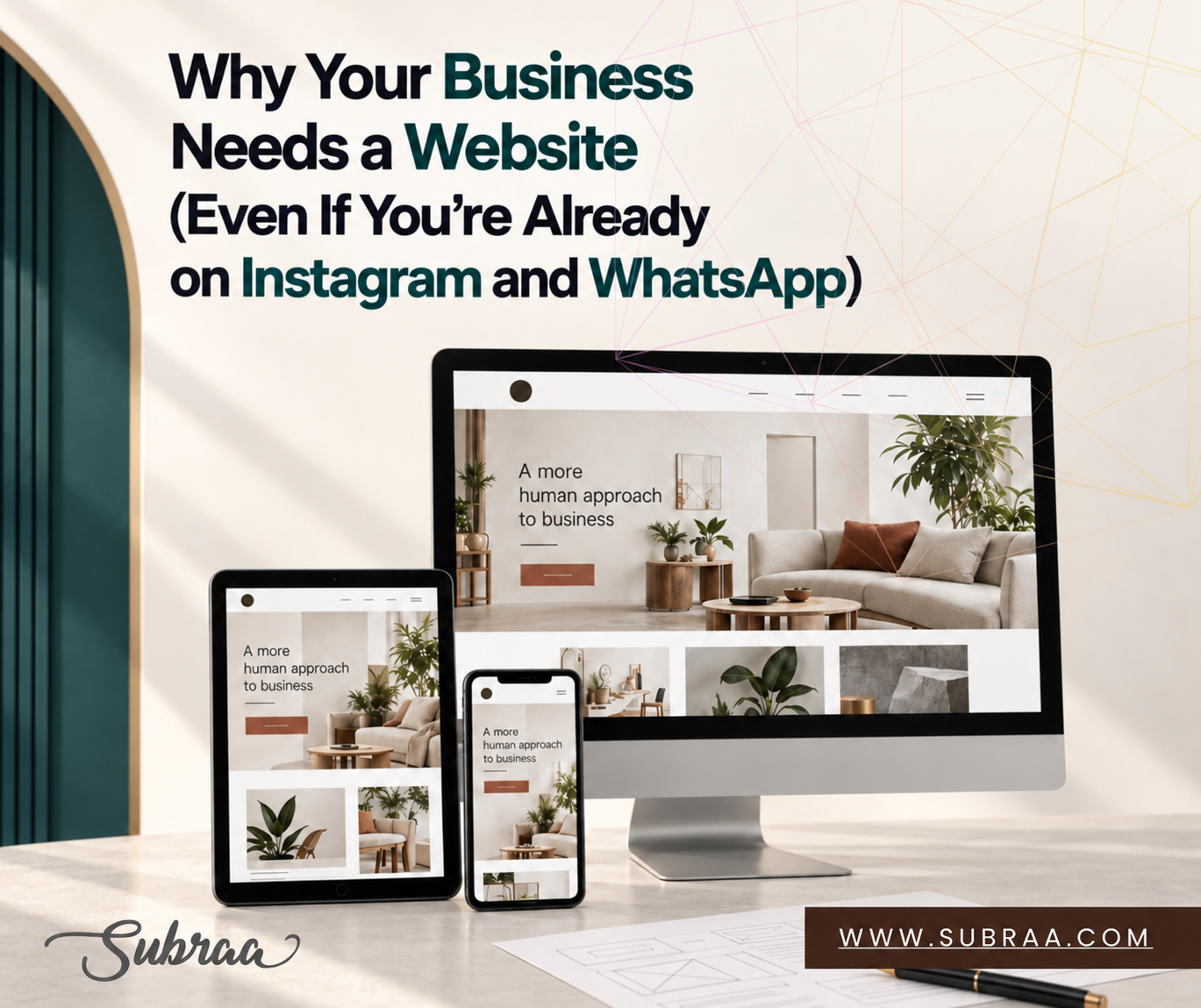
A website is a group of connected web pages that anyone can open in a browser such as Chrome or Safari. Each website lives at its own address, called a domain name, like www.subraa.com.
A typical business website has a Home page, About page, Services pages, a portfolio and a Contact page. Some also take bookings, sell products or let customers download forms.
How does a website work?
You only need to know five parts:
- Domain name: the address people type to find you.
- Web hosting: the server space that stores your site and keeps it online.
- Web design: the layout, colours, fonts and how easy the site is to use.
- Web development: the build work that makes everything function.
- Content management system (CMS): software like WordPress that lets you edit pages without code.
When someone types your domain, their browser asks your hosting server for your pages and shows them on screen. My beginner’s guide to domain names and web hosting explains this in plain English.
One thing matters more than the tech. Make sure your domain, hosting and admin login are registered under your company. If a freelancer or agency holds them in their own name, you can lose access to your own site.
What is the main purpose of a business website?
The main purpose of a business website is to help visitors understand what you do and take the next step, whether that’s calling, booking or buying.
That next step changes by business:
- A consultancy wants consultation requests.
- A restaurant wants reservations and menu views.
- A retailer wants online orders.
- A tuition centre wants parents to book a trial class.
Before you brief any designer, answer one question: what should a visitor be able to do within a minute of landing on your site? That answer shapes the structure, content and features.
Does My Small Business Really Need a Website?
For most Singapore businesses, yes. But needing a website doesn’t mean needing an expensive one.
A home-based bakery might need three pages: products, how to order, and contact. A corporate services firm might need a page for each service, team profiles and enquiry forms. The right size depends on how your customers buy, not on what your competitors spend.
Here’s the honest exception. If all your work comes from a small circle of repeat clients and you have no plans to grow, a website is less urgent. Even then, a simple one-page site stops you looking closed when someone searches your name.
15 Reasons Your Business Needs a Website
1. Customers can find you on Google
When people need an accountant, a contractor or a web designer, most start with a search. A website gives Google a page to show them.
It won’t rank automatically. Rankings depend on your content, technical setup and competition. But without a website, you have nothing that can rank at all.
2. It builds trust before the first call
Customers want to know who they’re dealing with before they spend money. A good website answers the basics: who runs the company, what you do, where you are and how to reach you.
Add real project photos and genuine reviews, and a stranger can judge you before picking up the phone. Keep every detail accurate. A polished site with an outdated address does more harm than good.
3. It works 24/7
Your office closes at 6pm. Your customers keep researching at 11pm.
A website lets them read about your services, check your location and send an enquiry any time. Parents comparing tuition centres after dinner, or overseas clients in another time zone, get answers without waiting for you.
4. You control it, not an algorithm
Facebook and Instagram decide your layout, your reach and your account rules. They can change any of these overnight.
Your website follows your rules. You decide the structure, the content and what visitors see first. You still rely on a hosting provider and domain registrar, but the space is yours.
5. It gives SEO something to work with
Search engine optimisation (SEO) helps search engines understand your pages and show them to the right people.
Say you run an aircon servicing company. A website lets you create separate pages for servicing, repair and installation, each able to appear in its own searches. A social media bio can’t do that.
Web design and SEO are not the same thing, though. A new site gives you the foundation. Rankings come from ongoing work, which is why I offer SEO services separately from design.
6. It turns word-of-mouth into enquiries
Referrals are still gold for small businesses. But few people call the moment they hear your name. They want to check your work first.
A website lets them do that. A friend recommends your interior design firm, the prospect opens your portfolio, reads your process and books a consultation. Your site finishes the conversation the referral started.
Imagine a renovation contractor whose customers come mostly from referrals. Without a website, every referred customer has to call just to see past work. With a simple site showing 10 finished projects and the renovation process, those same customers arrive already convinced, and the first call is about dates, not doubts.
7. It shows your services properly
Social posts are great for updates. Six months later, your key information is buried under newer posts.
A website keeps your offerings organised. A caterer can separate buffet menus, corporate packages and event catering. Customers shouldn’t have to message you just to find out what you sell.
8. It brings in leads
A website can give visitors several ways to reach you: enquiry forms, click-to-call numbers, email links, booking calendars and WhatsApp buttons.
In Singapore, a WhatsApp button often gets the fastest response. But buttons alone don’t create leads. Visitors need to understand what you offer and what happens after they get in touch.
9. You can sell online
An ecommerce website lets customers browse products, choose options, add to cart and pay on your own store.
A retailer with a physical shop can use an online store to keep selling after hours.
Not every business needs this. A consultancy may only need an enquiry form, and a clinic may need online booking instead. Pick features based on how your customers actually buy.
10. It carries your brand
Your website pulls your logo, colours, fonts, photos and tone of voice into one place.
If you’ve recently invested in professional logo design, your website should carry that identity through. A fresh logo on a dated site sends mixed signals.
11. It helps you compete with bigger companies
Smaller businesses rarely have big-brand marketing budgets. What they can have is clearer, more specific information.
A specialist who explains their niche well can win customers tired of vague corporate websites. A website won’t make you competitive on its own. It gives you a platform to show what makes you different.
12. It connects all your marketing
You might run Google Ads, post on Instagram, send emails and hand out name cards. Without a website, each channel says something slightly different.
Your website becomes the hub.
Ads point to a focused landing page. Social posts link to full service details. Your name card carries one address that has everything.
13. It answers repeat questions for you
“How much?” “Which areas do you cover?” “How long does it take?” If your team answers these every day, your website can answer them first.
A clear FAQ and detailed service pages let customers help themselves. You’ll still get enquiries, but they’ll be better informed and closer to buying.
14. You can measure what’s working
Unlike a flyer, a website shows you what visitors do. Free tools like Google Analytics and Google Search Console show which pages get visits, where visitors come from and how many get in touch.
If many people read your services page but nobody enquires, that’s your cue to rewrite it. Set up tracking in line with Singapore’s Personal Data Protection Act (PDPA).
15. It grows with you
You may start with three services and offer ten in five years. You may open a second outlet or start selling overseas.
A well-planned website grows with those changes. You add pages, features or an online store when you need them. That’s why the platform you choose on day one matters, even if you launch small.
Is Instagram, WhatsApp or a Google Business Profile Enough?
No, but they’re excellent partners for a website. Each channel does one job well, and your website ties them together.
| Channel | Best at | Where it falls short |
| Instagram / Facebook | Showing your work, building a following | Reach is set by the algorithm; key info gets buried; you don’t own the account |
| WhatsApp Business | Fast, personal conversations | Customers must already know you exist; no search visibility |
| Google Business Profile | Showing up on Google Maps and local searches | Little room for detailed services, case studies or FAQs |
| Your website | Explaining, persuading and converting in one place | Needs regular updates to stay accurate |
The strongest setup uses all four. A customer spots you on Instagram, checks your website to confirm you’re legitimate, then messages you on WhatsApp. Your Google Business Profile should link straight to your website.
What Type of Website Does Your Business Need?
Match the type to your main goal:
- Corporate website: introduces your company, services and credentials. Best for firms that mainly want enquiries.
- Small business website: a few core pages and simple contact options.
- Ecommerce website: product listings, cart, payments and order management.
- Portfolio website: shows past work. Ideal for designers, photographers, architects and renovators.
- Landing page: one page, one goal, often for an ad campaign.
- Booking website: lets customers pick a time slot and confirm.
Don’t pick the most complex option. Pick what fits today and can expand later. My guide to the different types of website design goes deeper.
What Makes a Good Business Website?
A good business website works well on phones, loads fast, makes information easy to find, is readable by search engines, and stays secure and up to date.
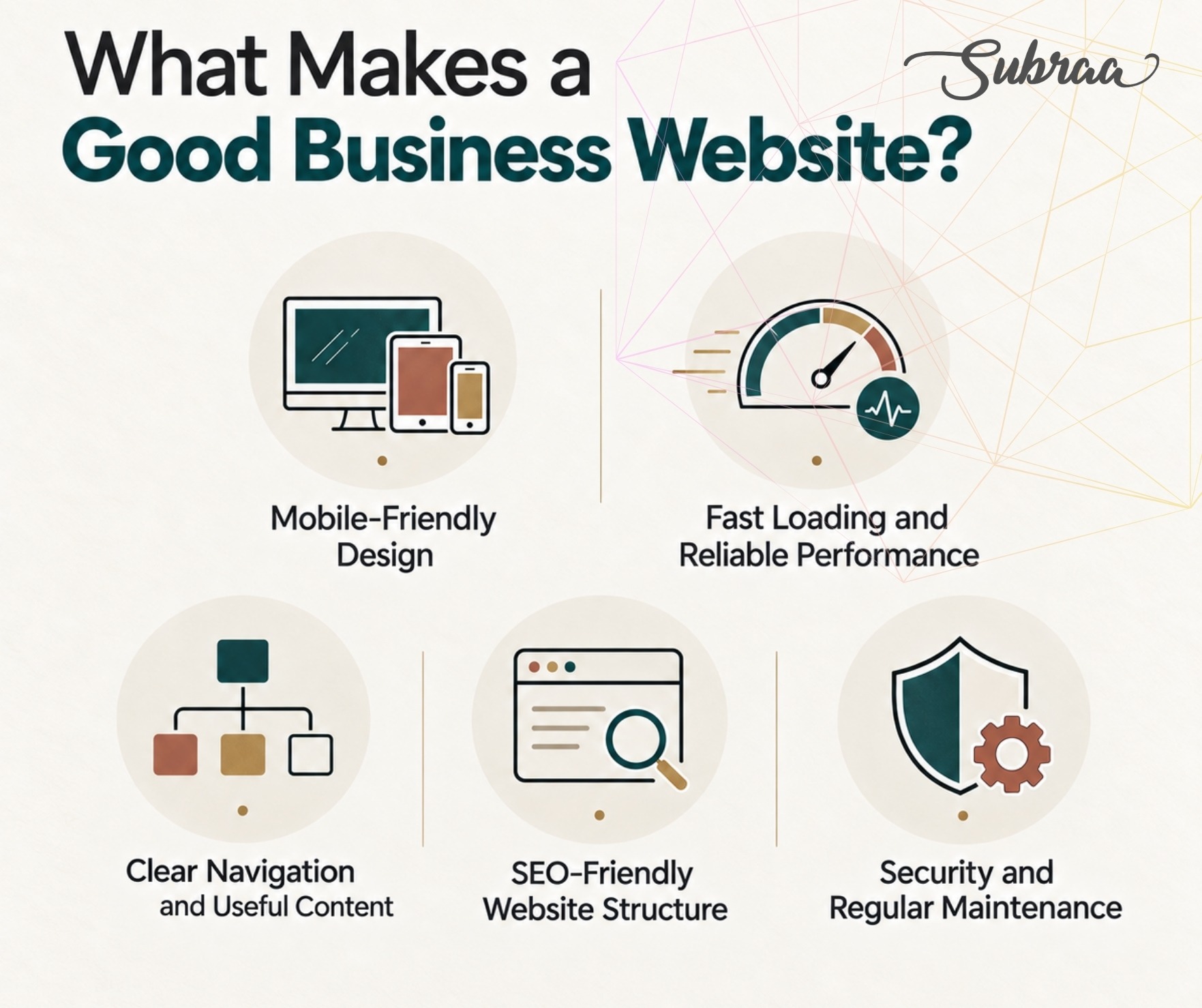
It works on every phone
Many of your visitors will arrive on a phone. Text must be readable, buttons easy to tap and forms quick to fill in. A desktop layout squeezed onto a small screen isn’t true responsive web design.
It loads fast
Heavy images, animations and bloated plugins slow sites down. Test your speed with Google PageSpeed Insights, not just on your designer’s fast office Wi-Fi.
It’s easy to find your way around
Visitors should never have to guess where to click. Use plain menu labels, clear headings and simple words.
Your phone number shouldn’t take three clicks to find. For structure ideas, see the four pages every business website needs.
Search engines can read it
A logical page structure, descriptive titles and crawlable pages give search engines a fair chance to understand you. Be wary of anyone promising first-page rankings just because they built your site. Google itself warns that no one can guarantee a #1 ranking.
It’s kept secure and updated
Websites need software updates, backups and security checks after launch. If your forms collect personal details, you also have PDPA obligations. My website maintenance guide explains what ongoing care involves.
Should You Build It Yourself or Hire a Web Designer?
DIY builders like Wix, Shopify and WordPress.com are fine if your needs are simple, your budget is tight and you have time to learn. AI website builders can now draft layouts and text in minutes, too.
What they can’t do is plan your structure, check your content is accurate, match your brand or keep your site secure. That part is still on you.
Hiring a web designer makes sense when you’d rather spend your time on the business, or when you need features like bookings or an online store. Whoever you choose, get clear answers on three things before you start: what’s included, who owns the site, and who looks after it after launch. My website design questionnaire helps you prepare.
Thinking About a Website for Your Business?
I’m Subraa, a freelance web designer in Singapore. Since 2011, I’ve helped 779+ clients across 50+ industries get online with WordPress websites, online stores and brand identities that match.
If you’re planning a new site or a redesign, start with three things: your goal, the features you need, and a budget range. Then browse my web design portfolio and compare my website design packages.
When you’re ready, send me a message. I’ll help you work out what your business actually needs, no more and no less.
Frequently Asked Questions
1. What is a website in simple terms?
A website is a collection of pages you can open on the internet using a web address. For a business, it’s where people learn what you offer, see your work and contact you. Some websites also handle bookings, online sales and customer accounts.
2. Why is a website important for a small business?
A website helps small businesses get found on Google, look credible to new customers and collect enquiries around the clock. It also gives you one place to send people from ads, social media and name cards. A few clear, well-built pages are often enough to start.
3. Do I need a website if I already use Facebook, Instagram and WhatsApp?
Yes, in most cases. Social platforms and WhatsApp are good for reach and conversation, but you don’t control their rules and your information gets buried over time. A website holds your full, searchable story, and your social channels and WhatsApp button can point people to it.
4. How much does a business website cost in Singapore?
It depends on the number of pages, the design work, the features and the platform. A simple informational site costs far less than a custom online store. Ask for an itemised quote covering design, development, hosting, maintenance and yearly renewals, so there are no surprises later.
5. How long does it take to build a business website?
A simple informational website usually takes a few weeks. Online stores and custom features take longer. The most common cause of delay is waiting for content, photos and approvals, so gather these early and agree on a timeline before work starts.
6. Will my website automatically appear on Google?
No. Google has to discover, crawl and index your pages first, and rankings depend on relevance, quality and competition. Adding your site to Google Search Console and publishing helpful, accurate content improves your chances, but nobody can guarantee a specific position.
7. Can ChatGPT and other AI tools recommend my business?
They can, when they find clear and consistent information about you online. There’s no guaranteed way to be recommended. Accurate service pages, a detailed FAQ, a complete Google Business Profile and genuine reviews all make it easier for AI tools to understand and mention your business.
8. Is WordPress a good choice for a business website?
For most small and medium businesses, yes. WordPress lets you edit pages and publish articles without code, and it can grow into an online store with WooCommerce. It needs good hosting, regular updates and security care, so plan for maintenance from day one.
9. Can I build a business website for free?
You can start on a free plan with some website builders, but expect platform branding, limited features and no custom domain. A free site is fine for testing an idea. For a long-term business presence, a paid plan or a professionally built site usually pays off.
10. Do I own my website if I pay a web designer?
Not automatically. Ownership depends on your contract, software licences and who registered the domain and hosting. Before you start, confirm in writing who owns the domain, design and content, and that you’ll get admin access. With Subraa, copyright transfers to the client once the project is completed and paid in full.
23 Sep 2026
Quick answer: A website is your business’s own address on the internet: a set of pages people can find on Google, read anytime, and use to contact you. Most Singapore businesses need one because…
01 Oct 2025
Not all websites are created equal and neither are their prices. In this blog, we break down what an affordable website design package in Singapore includes, what you should look for, and why it can be the smartest investment for your business.
26 Sep 2025
Choosing the right brochure size is key to making a lasting impact. In this guide, we cover standard brochure dimensions, folding styles, use cases, and printing tips—specially tailored for businesses in Singapore.
About Me

I’m Subraa, web designer, logo designer, Digital Marketer based in Singapore
- Search Post:
-
Recent Posts
- Why Your Business Needs a Website (Even If You’re Already on Instagram and WhatsApp) 23 September 2026
- Website Design Package Singapore: Cost, Features & Benefits Explained 1 October 2025
- Brochure Sizes and Dimensions: A Complete Guide for Your Business in Singapore 26 September 2025
- Kickstart your business in the New Year with a brand new website! 2 January 2026
- Black Friday Website Deal You Can’t Miss! 4 December 2025
- Tags
- brochure
- brochure design
- brochure design singapore
- business card
- business card design
- business logo design
- business name card design
- clinic logo design
- company logo design
- company name card design
- consultancy logo design
- crm logo design
- design a flyer
- f&b logo design
- flyer design
- flyer design singapore
- flyers
- flyers design
- food logo
- food logo design
- freelance logo designer
- freelance logo designer singapore
- freelance singapore
- freelance web designer
- freelance web designer in singapore
- freelance web designer singapore
- freelance web developer
- freelance website designer
- lifestyle logo design
- logo design
- logo designer
- logo designers
- logo design in singapore
- logo design singapore
- name card
- name card design
- product flyer design
- professional logo design
- property flyer design
- real estate flyer design
- singapore
- singapore flyer design
- subraa
- web design
- web design singapore